
If you’re searching for skincare advice that actually works, you’re not alone. With endless trends, viral routines, and conflicting product claims, it’s hard to know what truly benefits your skin. This article cuts through the noise to focus on what matters most: results-driven rituals, emerging trends worth your attention, and dermatologist approved skincare ingredients that consistently deliver visible improvements.
We’ve analyzed current skincare research, reviewed expert recommendations, and examined real-world results to ensure the guidance you’re about to read is accurate, practical, and rooted in science. Instead of hype, you’ll find clarity—what to use, why it works, and how to incorporate it into your routine effectively.
Whether you’re refining a minimalist regimen or exploring advanced treatments, this guide is designed to help you make confident, informed decisions for healthier, more radiant skin.
Your Guide to a Science-Backed Skincare Routine
Walk into any beauty aisle and the promises blur together—glass skin, poreless perfection, age reversal. No wonder it feels overwhelming. However, glowing skin rarely comes from a 12-step lineup. Instead, it hinges on dermatologist approved skincare ingredients used strategically.
So, what actually works?
- Retinoids boost cell turnover and smooth fine lines.
- Vitamin C brightens and fights free radicals (unstable molecules that damage cells).
- Broad-spectrum SPF prevents UV-induced aging.
Looking ahead, we may see more minimalist, evidence-first routines trending—less hype, more data. Think skincare’s back-to-basics era. Ultimately, it’s about right ingredients.
The Gold Standard for Anti-Aging and Acne: Retinoids
Retinoids are Vitamin A derivatives that range from gentle, over-the-counter retinol to prescription-strength tretinoin. In simple terms, they’re powerhouse ingredients that tell your skin cells to behave younger. Think of them as a personal trainer for sluggish skin (minus the whistle).
First and foremost, retinoids accelerate cell turnover, meaning they help shed dead skin cells faster. As a result, pores stay clearer and breakouts calm down. At the same time, they stimulate collagen production—the protein that keeps skin firm—reducing fine lines and improving uneven texture. Dermatologists consistently rank them among dermatologist approved skincare ingredients for both acne and aging concerns (American Academy of Dermatology).
So how do you start? Begin with a low concentration two to three nights a week. Apply a pea-sized amount to dry skin at night, then follow with moisturizer. Gradually increase frequency as tolerated. Most importantly, wear daily sunscreen—retinoids increase sun sensitivity.
With patience and consistency, retinoids can deliver real, visible results.
The Non-Negotiable Daily Essential: Broad-Spectrum Sunscreen
If you do nothing else for your skin, wear broad-spectrum sunscreen. Dermatologists agree it’s the single most important step for preventing premature aging and reducing skin cancer risk (yes, even more than that pricey serum). Some argue sunscreen is only necessary at the beach. However, UVA rays (the “aging” rays) penetrate clouds and windows, while UVB rays (the “burning” rays) cause sunburn. Broad-spectrum means protection from both.
So what should you look for? Mineral formulas with Zinc Oxide
Titanium Dioxide sit on top of skin and reflect UV—ideal for sensitive or acne-prone types. Chemical options with Avobenzone
Oxybenzone absorb UV and tend to feel lighter. Both use dermatologist approved skincare ingredients.
For daily use, apply SPF 30 or higher—two finger-lengths for face and neck. Reapply every two hours if outdoors, and after sweating or swimming. Pro tip: keep a travel-size in your bag so you’re never “caught off guard.” For more, see this broad-spectrum sunscreen guide.
The Protective Brightener: Vitamin C (L-Ascorbic Acid)
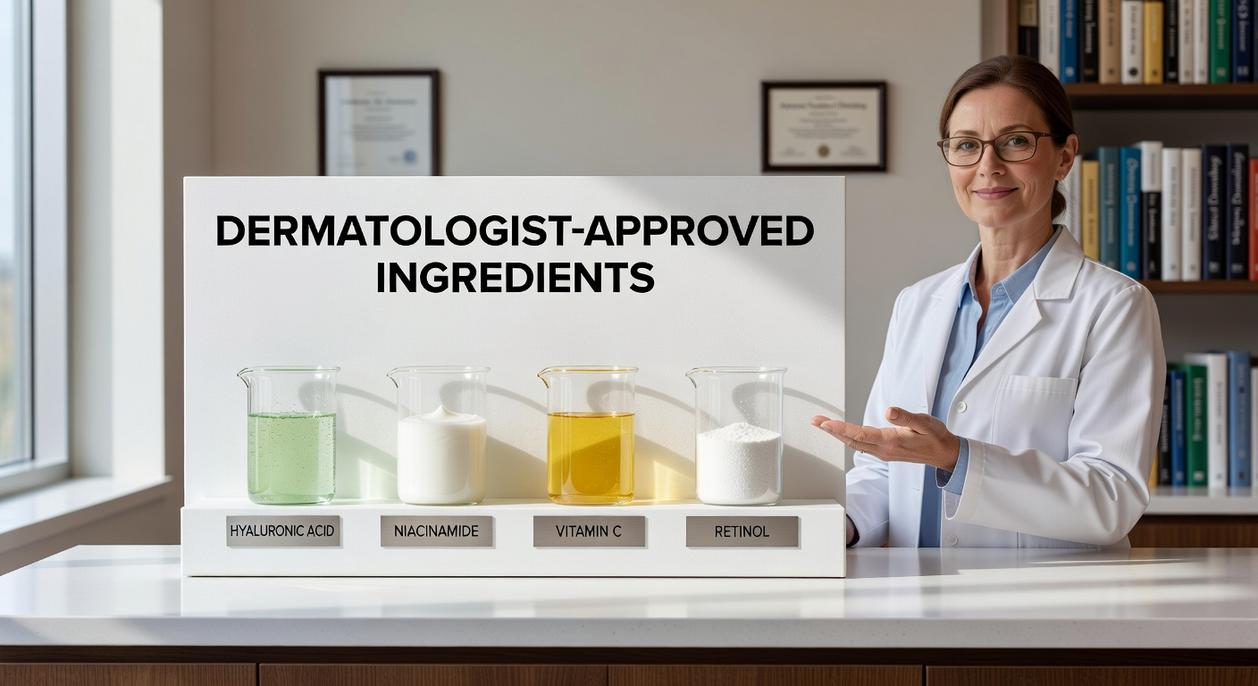
Vitamin C (L-Ascorbic Acid) is a powerful antioxidant—meaning it neutralizes unstable molecules called free radicals that damage skin cells. Free radicals form from UV radiation and pollution (yes, even that quick coffee run counts). Left unchecked, they accelerate premature aging, according to the American Academy of Dermatology.
Key Benefits
By neutralizing oxidative stress, Vitamin C helps:
- Brighten overall skin tone
- Fade hyperpigmentation (dark spots caused by excess melanin)
- Support collagen synthesis, the process that keeps skin firm and bouncy
Research published in the Journal of Clinical and Aesthetic Dermatology shows topical Vitamin C improves fine lines and uneven tone with consistent use.
Some skeptics argue antioxidants are “extra” if you already wear sunscreen. Fair point—but studies suggest Vitamin C actually enhances UV protection when layered underneath SPF. Think of it as a backup dancer making the star shine brighter.
Ideal For
If dullness, uneven tone, or sun damage are your main concerns, this is one of the dermatologist approved skincare ingredients worth prioritizing.
How to Incorporate
Use a Vitamin C serum in the morning after cleansing and before moisturizer and sunscreen. Choose opaque, airtight packaging to prevent oxidation (if it turns brown, it’s past its prime).
Prediction: As pollution levels rise globally, antioxidant layering will likely become a standard morning ritual—not a trend.
Pro tip: Store it away from heat and light to extend potency.
For a flawless finish after skincare, explore makeup artist picks must have brushes and tools.
The Universal Hydrator: Hyaluronic Acid
Hyaluronic acid is a humectant—a type of ingredient that attracts and holds water. In fact, it can bind up to 1,000 times its weight in water, which sounds dramatic (because it is), but that’s exactly why skin experts swear by it. As one of the most reliable dermatologist approved skincare ingredients, it delivers hydration without heaviness.
What does that mean for your skin? Plumper texture, softer feel, and a visible reduction in those fine lines that show up purely because your skin is thirsty—not aging overnight. I’ve found that when my skin looks dull, hyaluronic acid brings it back faster than most trendy serums.
It works for oily, dry, combination—everyone. Because it hydrates without adding oil, it won’t clog or suffocate pores.
- Pro tip: Apply it to damp skin, then seal with moisturizer. Without that final layer, the hydration can evaporate (and that’s just tragic).
The Smart Exfoliants: AHAs and BHAs
If you ask me, chemical exfoliants are far smarter than harsh scrubs (your skin isn’t a kitchen floor). Alpha-Hydroxy Acids (AHAs like Glycolic Acid) are water-soluble, meaning they work on the skin’s surface to dissolve dead cells. Translation: smoother texture and a noticeable glow. They’re my go-to for dull, rough skin that needs a quick radiance boost.
Beta-Hydroxy Acid (BHA, Salicylic Acid) is oil-soluble, so it slips into pores and clears out clogs. That’s why it’s ideal for acne and blackheads. If pores are your main drama, BHA is the peacemaker.
Core benefits? Improved texture, increased radiance, and decongested pores—basically the trifecta of dermatologist approved skincare ingredients.
Start low and slow. Use a low percentage 1–2 times per week to build tolerance. I strongly recommend applying them at night and never pairing with a retinoid at first. Overdoing it won’t speed results (it’ll just irritate your skin).
An effective skincare routine rests on a simple idea: use a few proven ingredients that target your specific concerns, not every trending serum on the shelf. Think of it as building blocks.
Start with Cleanse: remove dirt and excess oil so treatments can penetrate (that just means absorb properly).
Next, Treat: apply dermatologist approved skincare ingredients like Vitamin C in the morning to brighten and defend against free radicals—unstable molecules that damage skin—and a retinoid at night to support collagen, the protein that keeps skin firm.
Then Moisturize to seal in hydration.
Finally, Protect with sunscreen daily.
Stay consistent always.
Your Next Step to Healthier, Radiant Skin
You came here looking for clarity on what truly works in today’s crowded beauty space—and now you have it. From smarter routines to trend-forward techniques, you understand how choosing dermatologist approved skincare ingredients can transform not just your skin, but your confidence.
The real frustration isn’t trying new products—it’s wasting time and money on formulas that don’t deliver. Glowing, balanced skin starts with informed choices and expert-backed insights that cut through the noise.
Now it’s time to take action. Audit your current routine, swap in products powered by dermatologist approved skincare ingredients, and follow trusted beauty guidance that’s proven to work. Thousands of beauty enthusiasts rely on expertly curated insights to elevate their routines—join them and upgrade your skincare game today. Your best skin is one smart decision away.

 Richard W. has opinions about zosis pro makeup techniques. Informed ones, backed by real experience — but opinions nonetheless, and they doesn't try to disguise them as neutral observation. They thinks a lot of what gets written about Zosis Pro Makeup Techniques, Expert Collections, Beauty Hacks and Routine Upgrades is either too cautious to be useful or too confident to be credible, and they's work tends to sit deliberately in the space between those two failure modes.
Reading Richard's pieces, you get the sense of someone who has thought about this stuff seriously and arrived at actual conclusions — not just collected a range of perspectives and declined to pick one. That can be uncomfortable when they lands on something you disagree with. It's also why the writing is worth engaging with. Richard isn't interested in telling people what they want to hear. They is interested in telling them what they actually thinks, with enough reasoning behind it that you can push back if you want to. That kind of intellectual honesty is rarer than it should be.
What Richard is best at is the moment when a familiar topic reveals something unexpected — when the conventional wisdom turns out to be slightly off, or when a small shift in framing changes everything. They finds those moments consistently, which is why they's work tends to generate real discussion rather than just passive agreement.
Richard W. has opinions about zosis pro makeup techniques. Informed ones, backed by real experience — but opinions nonetheless, and they doesn't try to disguise them as neutral observation. They thinks a lot of what gets written about Zosis Pro Makeup Techniques, Expert Collections, Beauty Hacks and Routine Upgrades is either too cautious to be useful or too confident to be credible, and they's work tends to sit deliberately in the space between those two failure modes.
Reading Richard's pieces, you get the sense of someone who has thought about this stuff seriously and arrived at actual conclusions — not just collected a range of perspectives and declined to pick one. That can be uncomfortable when they lands on something you disagree with. It's also why the writing is worth engaging with. Richard isn't interested in telling people what they want to hear. They is interested in telling them what they actually thinks, with enough reasoning behind it that you can push back if you want to. That kind of intellectual honesty is rarer than it should be.
What Richard is best at is the moment when a familiar topic reveals something unexpected — when the conventional wisdom turns out to be slightly off, or when a small shift in framing changes everything. They finds those moments consistently, which is why they's work tends to generate real discussion rather than just passive agreement.